
Is your old lamp safe? A guide to lamp rewiring
A good lamp can be a design object, an art piece or a family heirloom. It is also a mains-powered appliance, and the part that decides whether it is safe, the wiring inside, is the part nobody looks at.
The numbers say the risk is small but real. In 2017-18, according to Scottish Fire and Rescue Service data, electrical lighting accounted for 75 accidental dwelling fires in Scotland, 1.6% of roughly 4,700. Add electrical supply and the figure rises to 413. Those figures cover all lighting, not just lamps, and they can’t tell us how many fires started with old wiring.
Nobody can tell us how many people are hurt by electric shocks, either. A pilot study by Public Health Scotland and Electrical Safety First says we currently don’t know how many injuries across Scotland are linked to electrical products, because there is no clear system for tracking them.
That gap is an additional reason to focus on prevention rather than statistics. A lamp that is old, second-hand or brought back from abroad is worth checking before it is switched on.
This guide covers the signs that an old lamp needs rewiring, what a proper rewire includes, how lamps are classed and tested, how to convert a foreign lamp for UK use, and what to look for when buying a vintage one.
Lamp electrical classification: class I, II and III
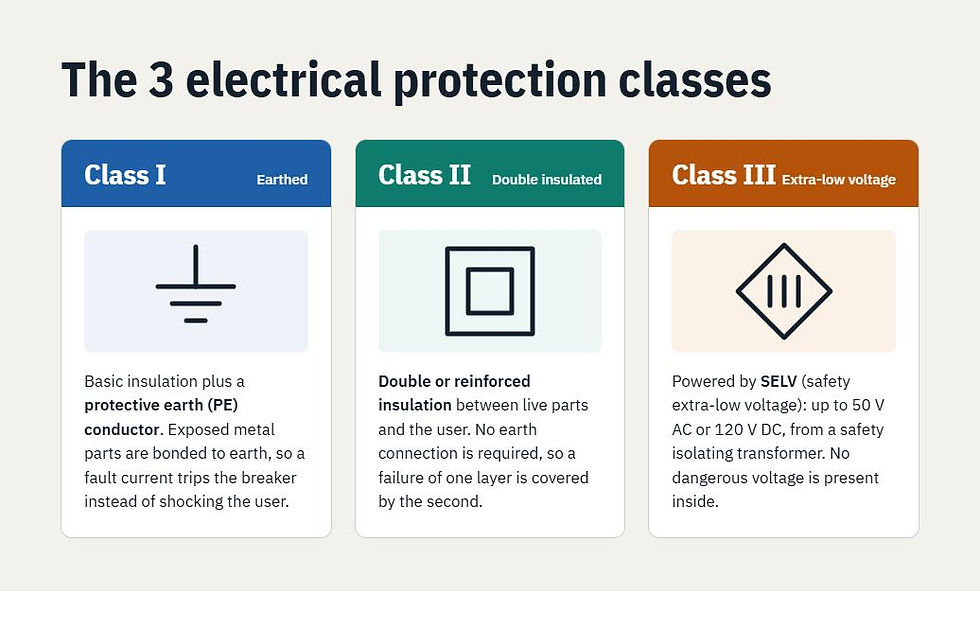
Every electrical lamp protects you from shock in one of three ways. That method is labelled by its class, and it decides how we rewire and test the lamp.
Class I: basic insulation plus an earth. The live parts are insulated, and any exposed metal is connected to the earth wire in the plug. If a fault makes the metal live, the current escapes through the earth and blows the fuse instead of passing through you. Class I lamps use three-core flex with a green-and-yellow earth wire. A solid brass table lamp is a classic example.
Class II: uses double insulation. Extra layers of insulation mean no earth is needed, so these lamps use two-core flex. A Class II lamp is usually marked with one square inside another (see more about it below). The class only holds if the lamp is fully insulated: if a metal part could become live, it isn’t Class II.
Class III: run on extra-low voltage. These lamps run on safety extra-low voltage, which means no more than 50 volts AC or 120 volts DC, supplied through a safety transformer or equivalent device. That is too low to cause a dangerous shock, so the lamp itself has no earth and needs none of the extra protection of Class I or II. Typical examples are 12-volt and 24-volt lamps, where only the transformer plugs into the mains.
A lamp gets its class when it is made, but we can improve an old one: when we rewire or repurpose a lamp built without an earth, we can add one, and it becomes a Class I lamp. Whatever the class, we match the flex, plug and fittings to it.
A note on very old lamps: some were made to a fourth category, class 0, with basic insulation only and no earth. Class 0 products have been prohibited from sale in the UK. Adding an earth can bring such a lamp up to Class I, but we assess each one first, because not every old lamp can be made safe.
Signs that an old lamp needs rewiring
The wiring inside an old lamp can fail long before the lamp looks worn: insulation hardens, connections loosen and plugs wear, and none of it is obvious from across the room.
These are the signs that a lamp needs rewiring before it is used again. Very important: do them with the lamp unplugged! If in doubt, don’t use it. Some faults, particularly in the insulation, can’t be seen.
Brittle or cracked flex: if the covering is stiff, cracked or flaking, or you can see bare copper, the insulation has failed.
Old fabric-covered or rubber flex: flex wrapped in cotton or covered in old rubber has often perished with age. Fabric-covered flex isn’t automatically a problem, because modern braided flex made for vintage-style lamps is perfectly safe (and we use it!).
Old colours inside the lamp: brown, blue and green-and-yellow are the modern colours. Red, black or plain green wires belong to the old colour code and show the lamp hasn’t been rewired in a long time.
A hot lampholder or plug: warmth from the bulb is normal, but a lampholder or plug that is hot to the touch, discoloured or scorched is not.
A wobbly, damaged or old-style plug: loose pins, cracks or a loose fuse, or a plug that is not a modern BS 1363 type are all warning signs.
No earth on a metal lamp: this type of lamp with two-core flex may have no earth connection at all, unless it carries the double-insulation symbol.
Joins, tape or loose connections: flex that has been joined, taped or repaired along its length, or that moves where it enters the lamp or plug, is not safe to rely on.
If everything looks fine, plug the lamp and try these two:
A flickering light, crackling or a burning smell: intermittent light, buzzing or any smell of burning means a fault, and the lamp should be unplugged straight away.
A tingle from the metalwork: if you feel even a mild shock from a metal lamp, stop using it immediately.
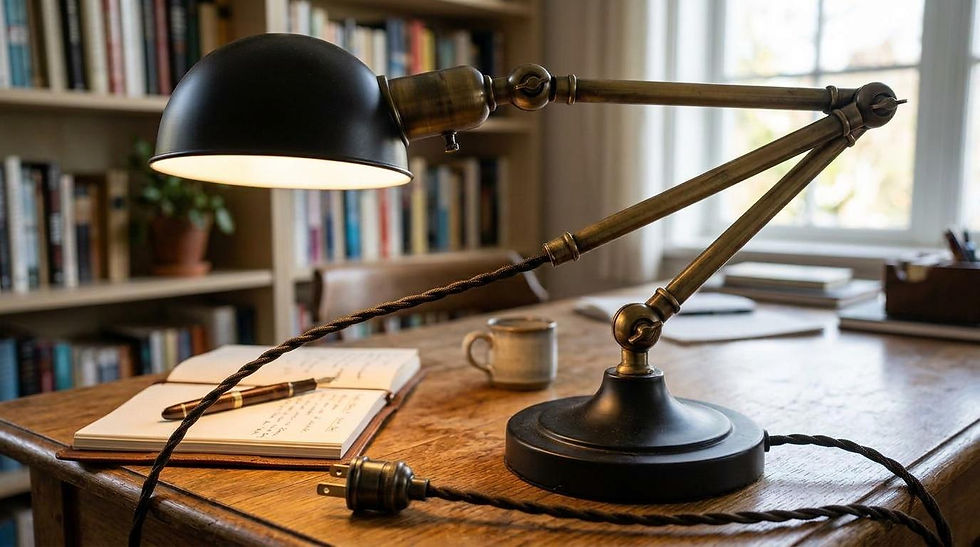
An old lamp can show none of these signs and still have deteriorated insulation, which is why a lamp of unknown age should be rewired and tested rather than judged by eye.
What a proper rewire includes
A proper rewire replaces everything that carries mains electricity to the lamp, then checks the work. This is what it should include.
New flex of the right type: the old flex should be replaced completely. The new flex should suit the lamp: heat-resistant where the lampholder or bulb will make it hot, and with the right number of cores for the lamp’s class (two for Class II, three for Class I). Modern flex colours are brown for live, blue for neutral and green-and-yellow for earth.
A plug with a suitably rated fuse: BS 1363 is the standard for UK three-pin plugs. The fuse is there to protect the flex, so it has to match it: 3 amp for typical lamp flex.
Cord grips: it clamps the flex where it enters the plug and the lamp, so a tug on the cable pulls on the grip rather than on the connections.
Earth continuity on Class I lamps: if the lamp has an earth, the connection should be tested to confirm it runs unbroken from the plug to the metalwork.
To see exactly what we do on every lamp, visit our lamp repair service page.
After rewiring, the lamp needs to be tested. Let’s see how.
The checks after the rewiring
A lamp that switches on isn’t necessarily a safe one. Once the rewiring is finished, we put every lamp through a PAT test (portable appliance testing) before it leaves the workshop, whether it’s yours or one of ours.
Visual inspection: we go over the whole lamp: flex, plug, fuse, lampholder, cord grips and any metal parts. The flex must match the lamp’s class (I or II), and every part should be the right type, secure and undamaged.
Earth continuity (Class I only): we test that the earth runs unbroken from the plug to the metalwork, so a fault has somewhere safe to go.
Insulation resistance (Class I and II): we test that the insulation keeps the live parts away from anything you can touch.
Label and record: each lamp gets a label, and the results are written down: what the lamp is, its class, the date and what the tests showed.
PAT testing follows the IET Code of Practice. For a lamp in your own home it’s guidance rather than a legal requirement, but we test as standard, and every lamp we sell is tested the same way before it’s sold, with a record kept.
Overseas or EU lamp conversion for UK use
A lamp that works perfectly in Paris or Boston can’t simply be plugged in here.
Three things can differ: the plug, the lampholder and bulb, plus the voltage. Which of them needs changing depends on where the lamp comes from.
European lamps
Usually a plug job. The UK runs on 230 volts at 50 hertz, and most of the EU is also 230 volts, so a lamp built for the continent normally has the right voltage.
What it lacks is a UK plug. The proper fix is a BS 1363 plug with a fuse matched to the flex (3 amp for typical lamp flex), and three-core flex with an earth for a Class I lamp. A fused conversion plug marked to BS 1363-5 is an alternative, but a two-pin conversion plug is suitable only for unearthed Class II lamps.
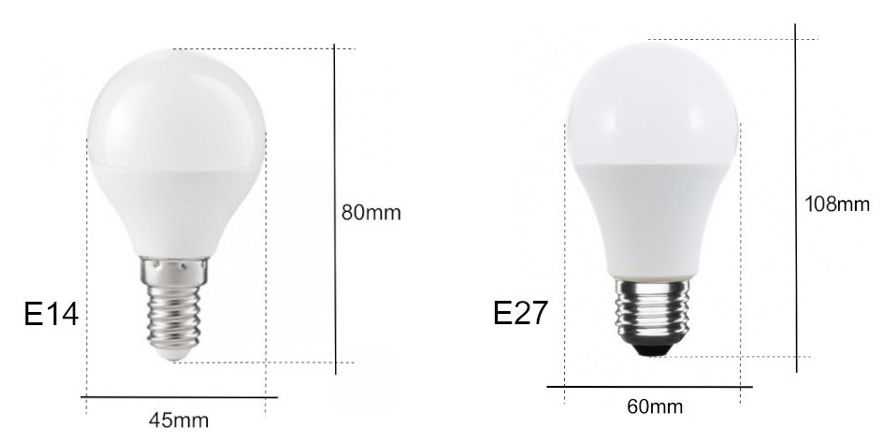
UK lamps use B22 bayonet or E27 screw bulbs, while most European lamps use E27 (sometimes E14). A plain travel adaptor is not a conversion: it changes the plug type and does not convert voltage.
American, Canadian and Japanese lamps
In these cases, voltage is the real problem.
North American mains is nominally 120 volts at 60 hertz, while Japan’s is around 100 volts, against 230 volts here.
A lamp or bulb built for 120 volts must not be run on UK mains: a 120-volt bulb on a 230-volt supply flashes brightly and burns out instantly, and the lamp itself may not be built for the higher voltage.
There are two safe routes.
The lamp can be run through a suitably rated voltage transformer.
It can be properly rewired for 230 volts with a new lampholder, new flex and bulbs rated for UK mains.
Changing the plug alone is never enough.
North American lamps use E26 screw bulbs. The US thread differs from the European one, so the lampholder usually has to be replaced as part of the rewire. Bulb adapters for E26 and E27 exist, but they do not convert voltage, so they only solve the fit, not the mains difference.
A proper conversion includes the same elements as any rewire: new flex of the right type, a BS 1363 plug with the right fuse, cord grips, earth continuity on Class I lamps and a final electrical test, plus a lampholder and bulbs matched to 230 volts where the lamp came from a lower-voltage country.
If you have a lamp from overseas that needs converting, see our lamp repair service page for what we do.
Buying vintage lamps: what to check before you pay
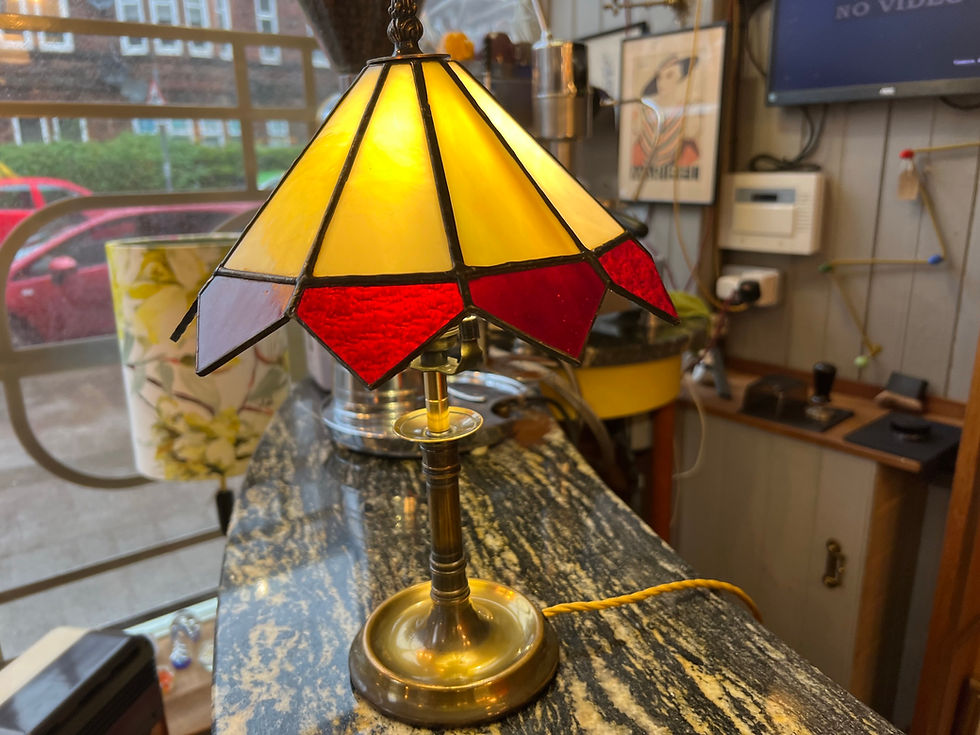
A vintage lamp can look perfect and still have wiring that has outlived its insulation. Before you buy it, go through the signs above with the lamp unplugged, then ask the seller:
Has it been rewired, when and by whom? Was it tested, and is there a label or a record?
What fuse is in the plug? Lamps normally need a low-rated fuse, typically 3 amp, not the 13 amp fuse that often comes in a plug.
Is it Class I or Class II? A metal lamp with two-core flex is a warning sign unless it carries the double-insulation symbol.
What is the maximum bulb wattage? Never exceed the wattage marked on the lamp.
Stay nearby when you first switch it on. If you notice a burning smell, a hot plug or lampholder, or flickering, unplug it straight away.
This checklist is not a substitute for proper rewiring and testing. If a lamp fails any of these checks, or you can’t tell, bring it to us.
At Battlefield Restoration we offer the lamp repair service where rewiring is one of the most frequent needs.
We can check it for you and, if needed, make it fully functional again.

Comments